

“AI data centers in Texas used 463 million gallons of water, as residents are told to take shorter showers.” So said Brut, a top social-first news organization for millennials and Gen Z, in an Instagram post that has since received 136,000 likes.
Let’s not debate the facts averred by Brut about water or showers right now. Let’s focus on what is going on culturally, so that AI data center developers and their investors can get a sharper view of how to handle a growing reputation crisis in the AI infrastructure build-out.
The chord that Brut is striking here is a common recognition that communities around the United States are articulating: the cost-benefit asymmetry of the data center build-out is unacceptable to them. The future benefits of AI are diffuse and increasingly perceived as national, whereas the costs are concentrated and local. As one Instagram user put it, “Is the promise of AI worth destroying our home?”
The problem
The AI infrastructure sector is self-extinguishing its social license to operate: the unwritten, revocable acceptance that communities extend to companies over and above what the law requires. This is different from legal license, which can be understood as compliance with laws, regulations, and rules that apply within a jurisdiction.
But the mainstream practice for developers of AI data centers – which the industry has rebranded as “AI factories” – has been to conflate social with legal license. There are exceptions, but as Harvard Business School Professor George Serafeim aptly pointed out, this error underlies significant losses in planning and legal spend for data center developers, their partners, and investors. These economic actors are waking up to the lesson that the mining and extractives industries already learned: that permits from local authorities are worthless when communities revoke social license to operate by tying up projects in municipal council votes, courts, ballot recalls, and reputational harm until their economics collapse. At least $64B in U.S. data center construction projects were blocked or delayed by local opposition between 2024 and May 2026, according to Yahoo!Finance. This figure doesn’t include the June 2026 withdrawal of the $30B project known as Digital Gateway in northern Virginia, which was canceled in the face of a long-running opposition that reached the state’s supreme court.
Cultural catalysts
For companies that build data centers, community relations management is not a nice-to-have but a critical pathway to delivery.
There is growing perception in communities that the build-out is “rigged” against them. That’s an actual word being used to describe it. It’s a lightning rod borrowed from other contexts and notoriously capitalized upon by President Donald Trump when he uses the term “rigged” to insist that U.S. elections have pervasive voter fraud. We now see the word marshaled by data center opponents; for example, a contributor to the South Pasadenan (a publication serving southern California towns) wrote in May that we can learn from the Monterey Park data center controversy in these terms: “The lesson is not that residents are powerless. The lesson is that when notice is rigged and reviews are streamlined, residents have to fight a war just to be heard.”
Takeaway for AI data center developers, their business partners, and investors
To derisk community opposition and actually get to a constructive outcome, developers need separate empathetic approaches for addressing people who feel swindled and mobilizing supporters. Far from sowing division, these distinct strategies need to build consensus. If people feel that a project is slated against their community, you get virtually nowhere by hitting them with science and engineering facts on substantive issues like power, water, or noise. New rituals are needed to help people and companies be agents of change.
While “social license to operate” is jargon known to only a few, “rigged” is the cultural catalyst that data center providers need to recognize and respect. It needs to inform their risk management, public relations, and strategic communications execution. In turn, it needs to inform investors’ diligence and stewardship activities.
Glyptique Consulting LLC is an advisory partner helping investors in the AI infrastructure value chain translate diffuse signals about regulatory, reputational, and ESG constraints into clear communication and stewardship strategies.
Request a complimentary conversation here.
July 7, 2026
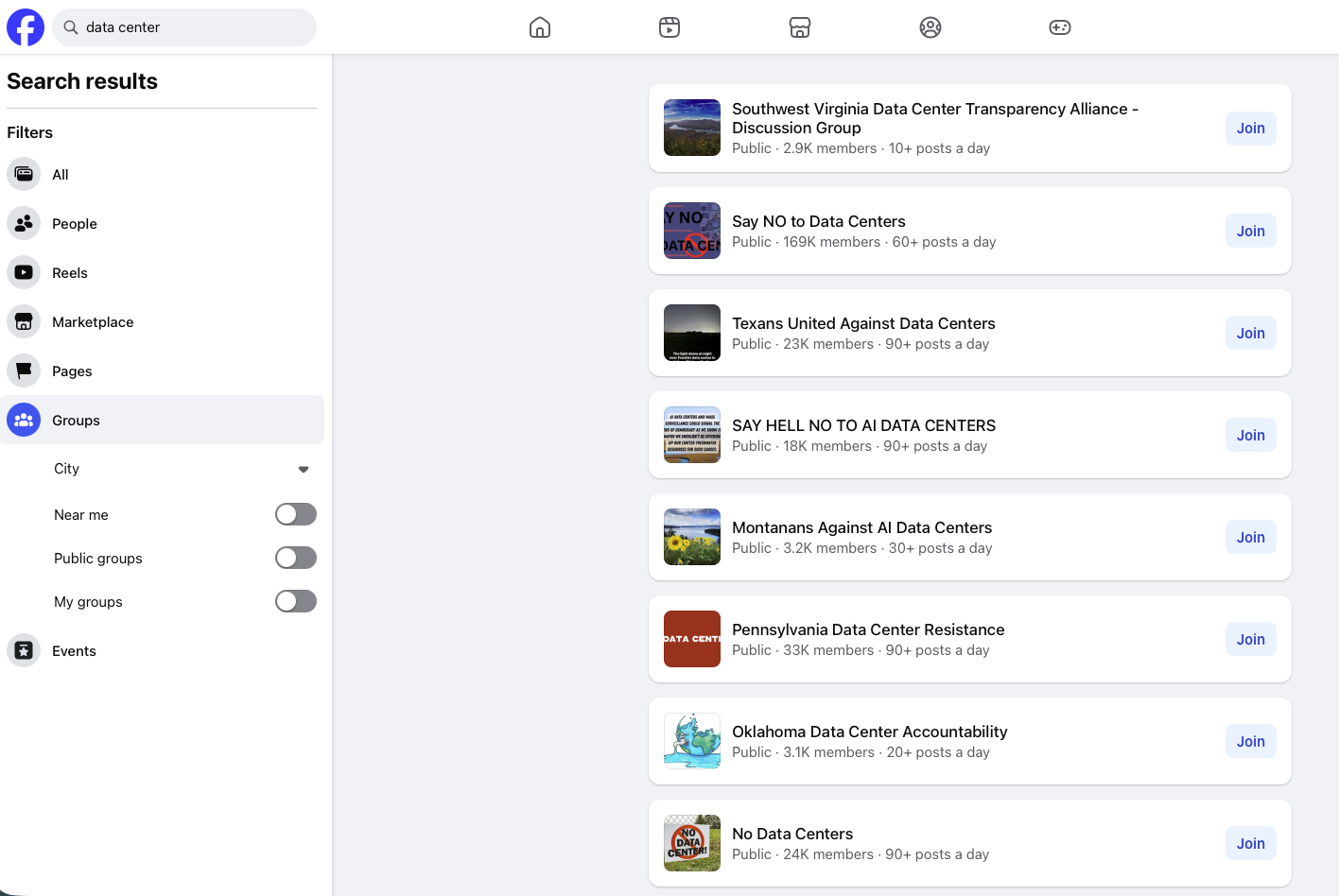
A search for “data center” in Facebook Groups. June 10, 2026
